Testing 101
Which tests to order, which lab to use and how to read the certificate that comes back.
Test the vial, not the promise.
Which tests to order, which lab to send them to and how to read the certificate that comes back — the community's testing playbook, connected to the reports on this marketplace.
What is testing?
Testing analyses a product to confirm it meets a standard for quality, composition and amount. The data it produces is what trust in a vial should rest on.
- Chosen and paid for by the party selling the vial
- Often for a batch, not the vial in your hands
- Can be subject to bias
- You pick the lab and send the vial you received
- Confirms the right product and the right amount of active ingredient (API)
- The evidence behind an escrow claim
Group testing
Buyers with the same batch send several vials and split the bill. More samples, a cheaper test, and a far better picture of the batch.
- Batch-wide, not one vialOne vial 5% under-filled says little on its own — others may land on or above the label. Several samples give a real average mg per vial.
- Shared costPooling orders makes purity, mass and endotoxin testing affordable for everyone in the group.
- The group decidesKeep results private for a few weeks to reward the people who paid, share at once, or not at all. Aggregated data on brands helps the whole community.
Which tests to order
Wrong peptide, wrong dose and degraded product have happened with every vendor at some point — usually from missing quality control, bad raws or poor finishing. This is what to test, and how often.
Why it matters
Purity reflects the quality of synthesis — a stable peptide with minimal deamidation. Mass confirms the advertised quantity is actually in the vial. Ask for the raw data so the result can be validated. More on what purity means in the gray market: this guide .
Why it matters
Endotoxins — mainly lipopolysaccharides (LPS) from gram-negative bacteria — are unlikely to form during solid-phase peptide synthesis, but vendors rarely disclose their manufacturing process or standards. A Limulus Amebocyte Lysate (LAL) test confirms acceptable levels.
Why it matters
TFA salt is cheaper to make than sodium or acetate forms, and undesirable for long-term weekly injections. Periodic NMR F-19 tests guard against a brand quietly switching. More in Residual Solvents.
Why it matters
There is no "safe" level of heavy metals in a peptide. Periodic monitoring confirms their absence and adds a layer of safety.
Check the Test Data spreadsheet first — someone may have tested your brand recently.
The detail
Sterility tests incubate samples in growth media for a couple of weeks, and many vendors would fail through contamination in manufacturing or handling. Filtering with a 0.22 μm polyethersulfone (PES) filter and aseptic technique mitigates this. Bacterial growth in lyophilised vials stored in the freezer is not a significant concern.
The detail
Class 2 solvents used in SPPS (DCM, DCA, DMF, ACN, NMP) pose low risk and are removed by proper lyophilisation. Class 1 solvents are not known to be used in SPPS and all boil below 85 °C, so they are very unlikely to survive vacuum drying (ICH Q3C ). If TFA is absent, Class 1 residues almost certainly are too.
Which lab to use
Many domestic labs — university labs included — can run HPLC and NMR. These are trusted options at home and abroad.
- HPLC: offered
- NMR F-19: offered
- Endotoxin: offered
- Heavy metals: offered
- HPLC: offered
- NMR F-19: not offered
- Endotoxin: offered
- Heavy metals: not offered
- HPLC: not offered
- NMR F-19: offered
- Endotoxin: not offered
- Heavy metals: not offered
Reading your results
What a pass looks like for each test, how labs calculate it, and two checkers to run your own numbers.
HPLC
HPLC shows how well a peptide was synthesised and how stable it has stayed — purity, accounting for degradation. We use >98% as the benchmark, in line with FDA-regulated 503A/B compounding. It also measures API mass: ±10% is our standard, matching what many vendors guarantee. USP <905> allows ±15% batch variance, with no single unit more than ±25% from target.
The method is calibrated for one peptide against a reference standard . If that peptide is absent there is simply no peak. Once a peak appears at its expected retention time (RT), the area under the curve (AUC) gives purity and mass. Smaller nearby peaks are usually degraded peptide (deamidation) or similar-sized compounds, and are generally included in the purity calculation.
Labs differ on which small peaks they count. Degraded peptide is typically included, "unidentified filler" may be excluded, and known fillers like mannitol (a lyophilisation stabiliser) are never counted. That is why you should always request the raw data — it usually explains a purity gap between two labs.
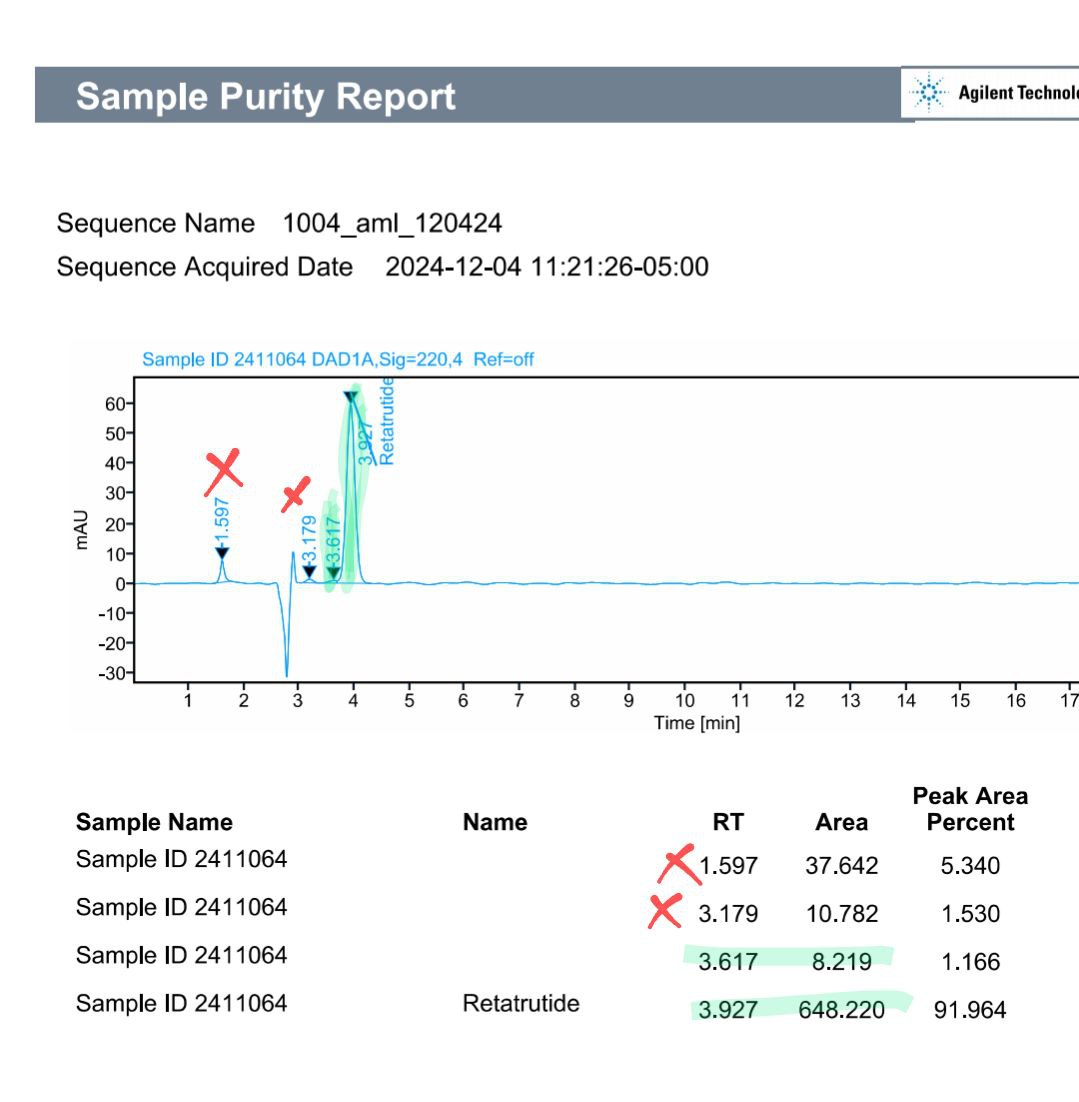
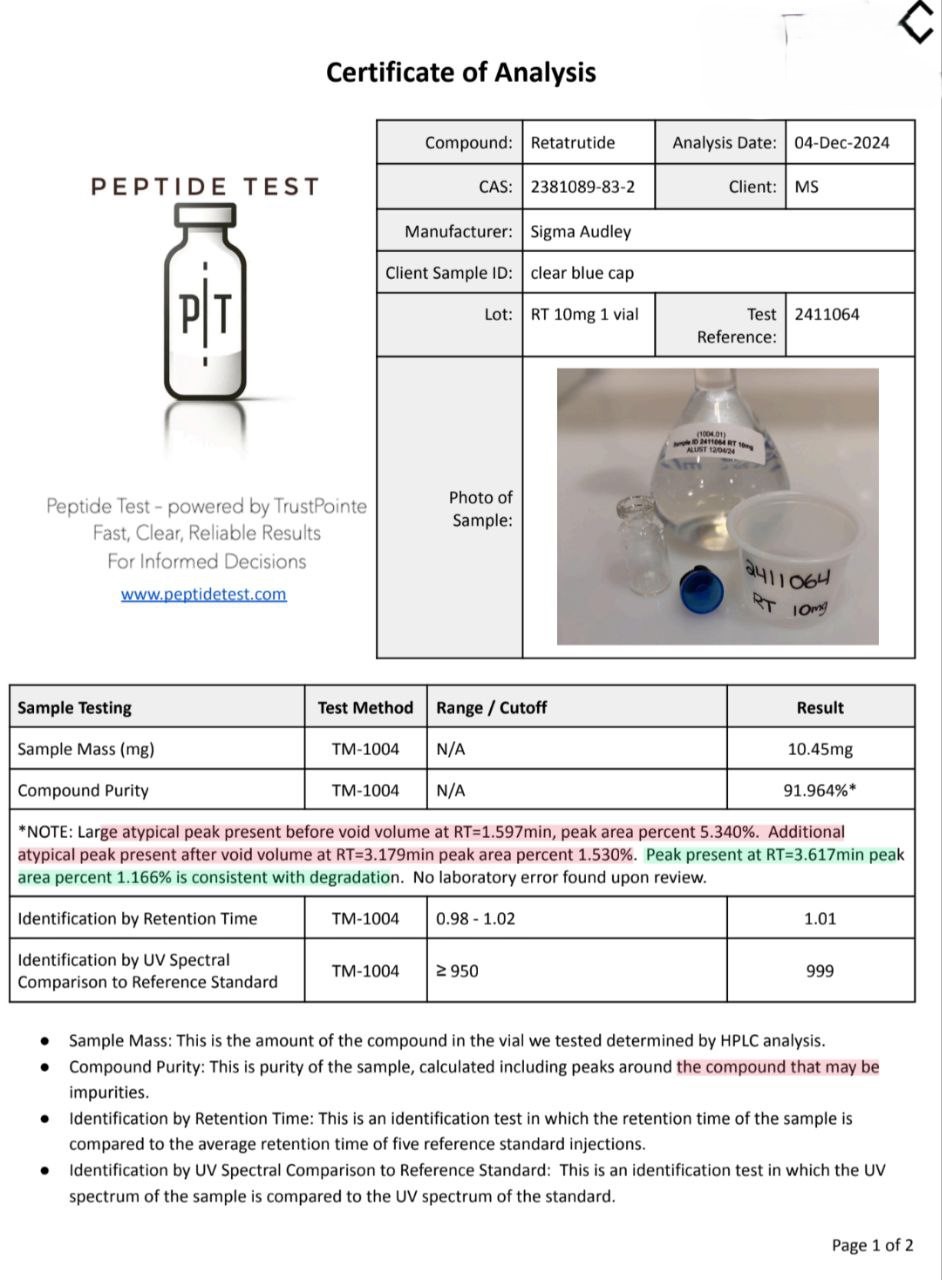
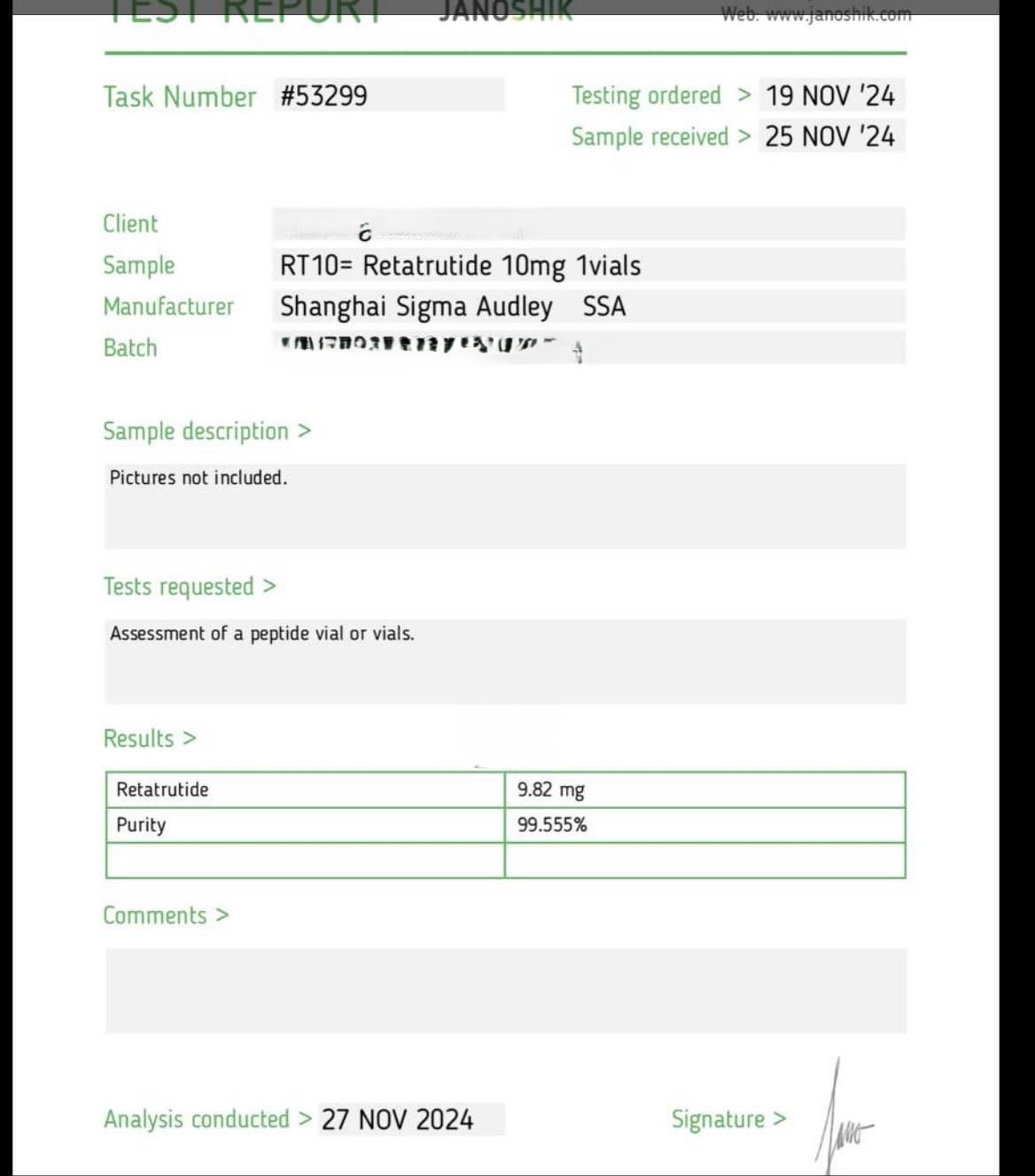
PeptideTest counted two small peaks (37.642 and 10.782) as "unknown filler" in its total; Janoshik did not. Remove them and the PeptideTest purity lines up with Janoshik's within normal error:
648.220 ÷ (648.220 + 8.219) = 648.220 ÷ 656.439 = 98.75%
* counted as filler by PeptideTest only.
NMR F-19
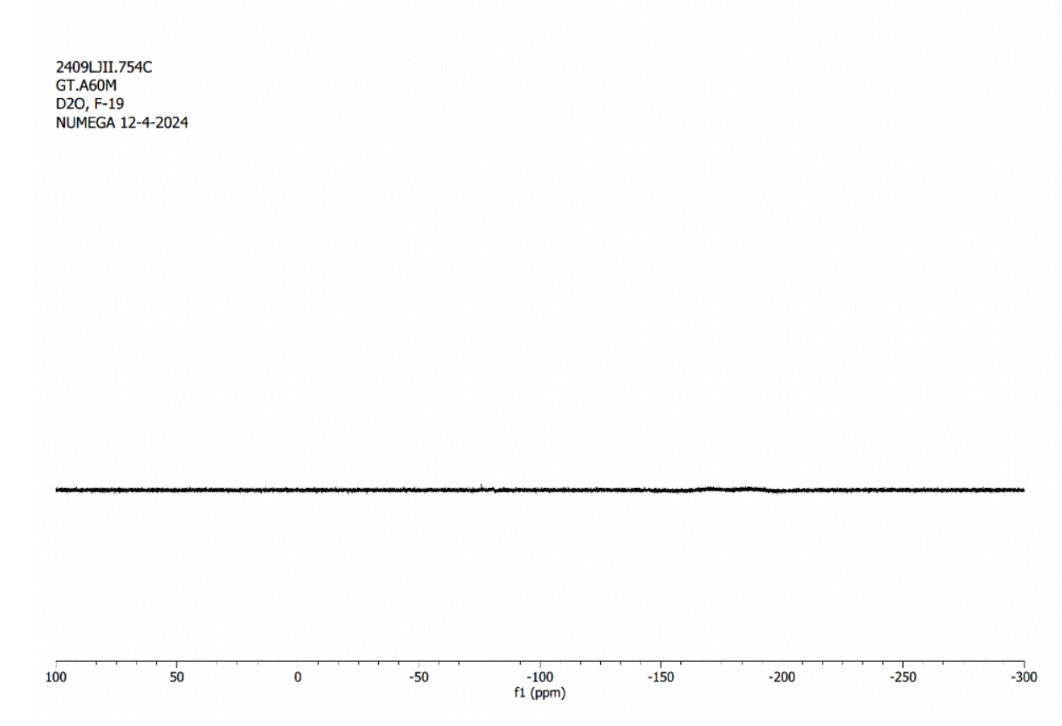
Fluorine-19 NMR detects and quantifies trifluoroacetic acid (TFA). With three fluorine atoms, TFA gives a distinct, highly sensitive signal around −76 ppm, which makes this method ideal for catching both residual TFA and the TFA salt form.
Endotoxin
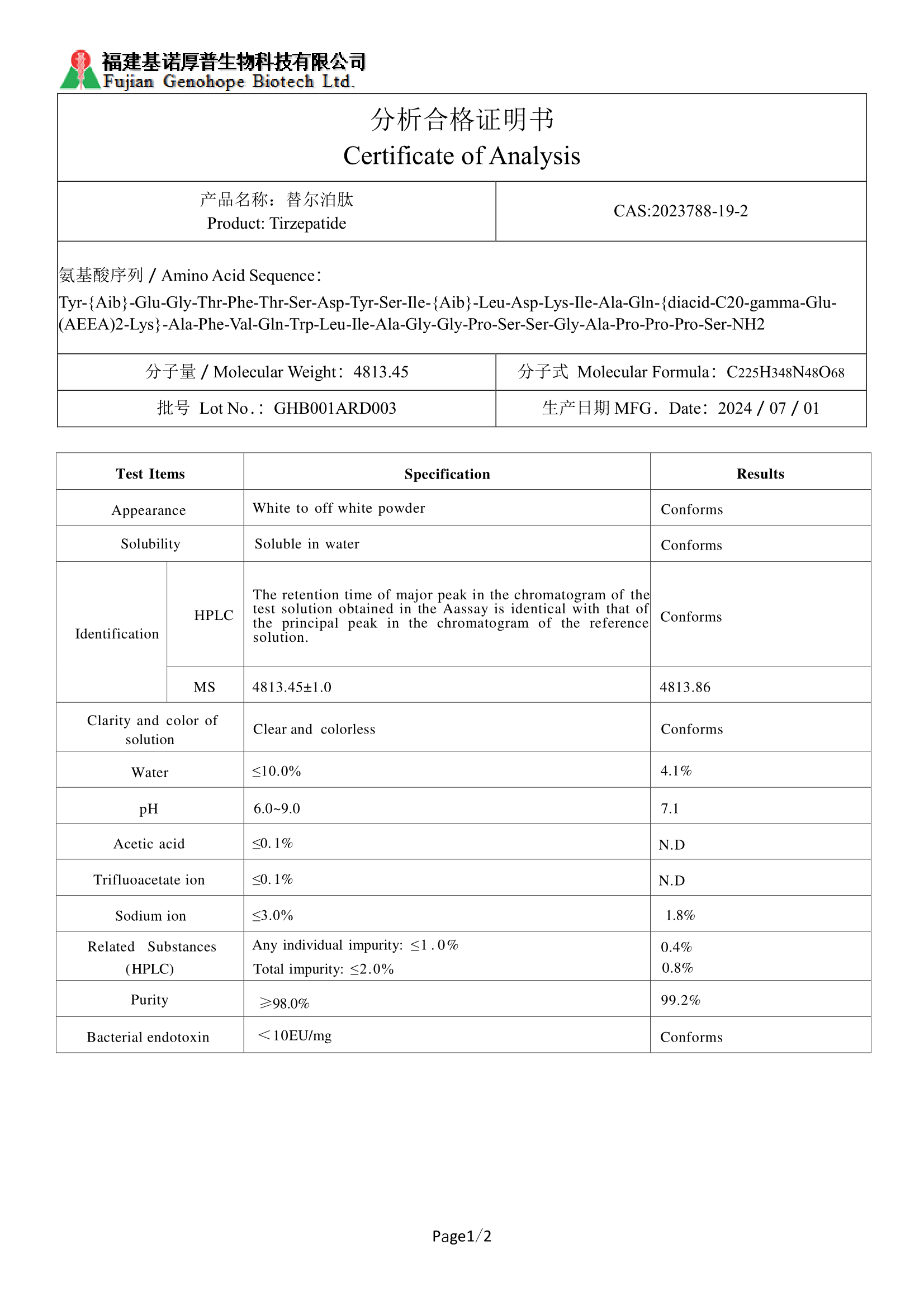
The LAL assay detects lipopolysaccharides, toxic components of bacterial cell walls, measured in endotoxin units (EU). FDA-regulated 503A/B pharmacies sourcing tirzepatide work to <10 EU/mg of API. USP also sets 5 EU/kg body weight/hour, but that covers every source of endotoxin over a period, so we recommend the simpler 10 EU/mg standard (source ).
Reports EU for the whole vial.
EU/mg = X EU ÷ Y mg30 mg vial, 6 EU → 6 ÷ 30 = 0.2 EU/mg ✓
Reports EU/mL, with the sample dissolved in 2 mL.
EU/mg = X EU/mL ÷ (Y mg / 2 mL)30 mg vial, 8 EU/mL → 8 ÷ 15 = 0.53 EU/mg ✓
Reports on the marketplace
Every listing on Grey Markets shows its lab report next to the price — 102 reports across 140 listings so far. The newest:
While an order is in escrow, a failed independent test — wrong compound or a significant under-fill — is grounds for a claim. The brand is not paid until it is resolved.
Community guide, originally published May 23, 2026 by seeker-seventy-six and the mods, migrated from the Grey Markets community site. Questions or feedback on the information or sources? Reach the mods on Telegram — the invite is in the footer. Not medical advice; for research and education only.
Your Cart



All Categories
Search

Before you enter
Grey Markets lists research peptides for laboratory and educational use only. Nothing on this site is medical advice or intended for human consumption.
By continuing you confirm that you are 21 or older and agree to our Terms of Service.